Building the design process.
A documented, five-stage framework that turned inconsistent execution into repeatable, trusted delivery — built with my team, and built into our cross-functional partners’ expectations, not just ours.
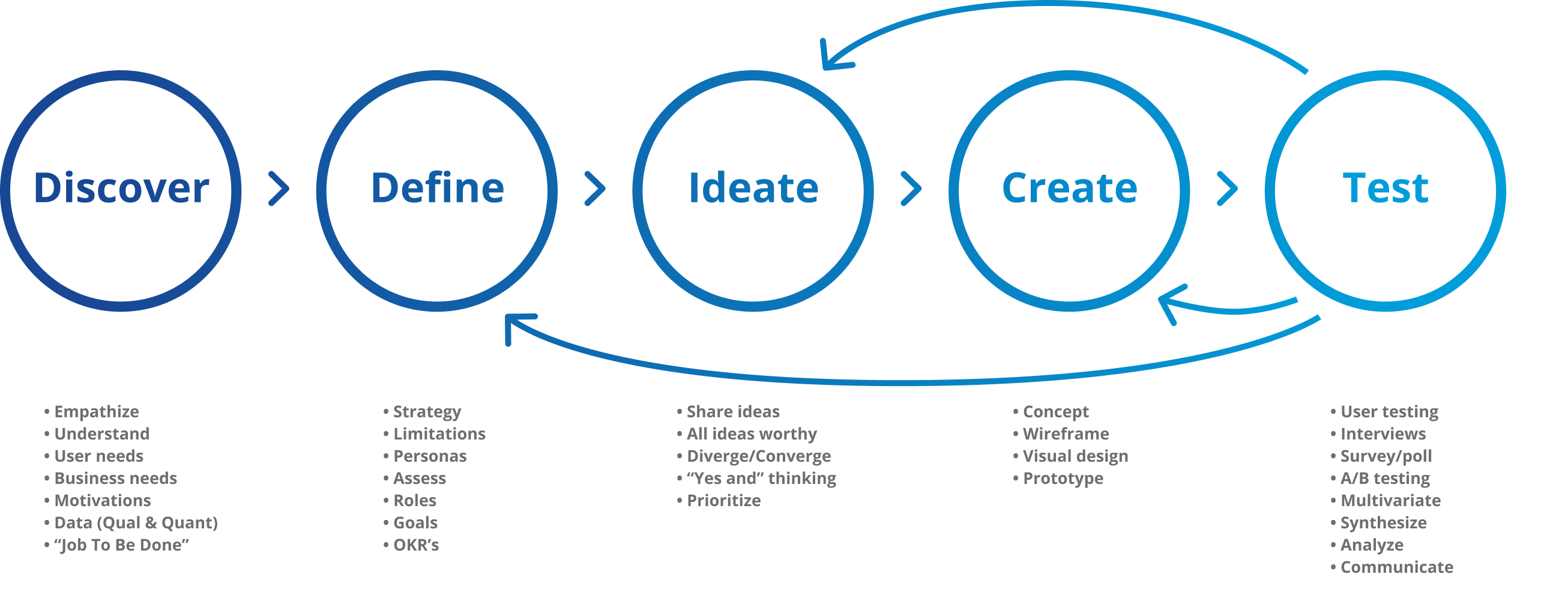
Before this framework, execution was ad hoc. Some projects succeeded and some didn’t, with no consistent way to predict which outcome to expect or to explain the difference afterward.
That inconsistency was more than a delivery risk. Cross-functional partners and executives couldn’t reliably set expectations around scope, timing, or what a project would actually produce — and a string of projects that didn’t fully land eroded confidence in the design organization’s ability to deliver, overall.
The framework
1. Discover
- Empathize
- Understand
- User needs
- Business needs
- Motivations
- Data (qual & quant)
- “Job to be done”
2. Define
- Strategy
- Limitations
- Personas
- Assess
- Roles
- Goals
- OKRs
3. Ideate
- Share ideas
- All ideas worthy
- Diverge / converge
- “Yes, and” thinking
- Prioritize
4. Create
- Concept
- Wireframe
- Visual design
- Prototype
5. Test
- User testing
- Interviews
- Survey / poll
- A/B testing
- Multivariate
- Synthesize
- Analyze
- Communicate
A process people actually follow
A framework only works if the people outside your team follow it too, so I built it with them, not for them. I built relationships of trust and communication with cross-functional leaders and leveraged their input while creating the process, so their buy-in was baked into the final version rather than requested after the fact.
Rolling it out got the same treatment as any other launch: I built alignment and set expectations across the organization ahead of time, so no one was caught off guard by a new way of working.
The Discover phase, in practice
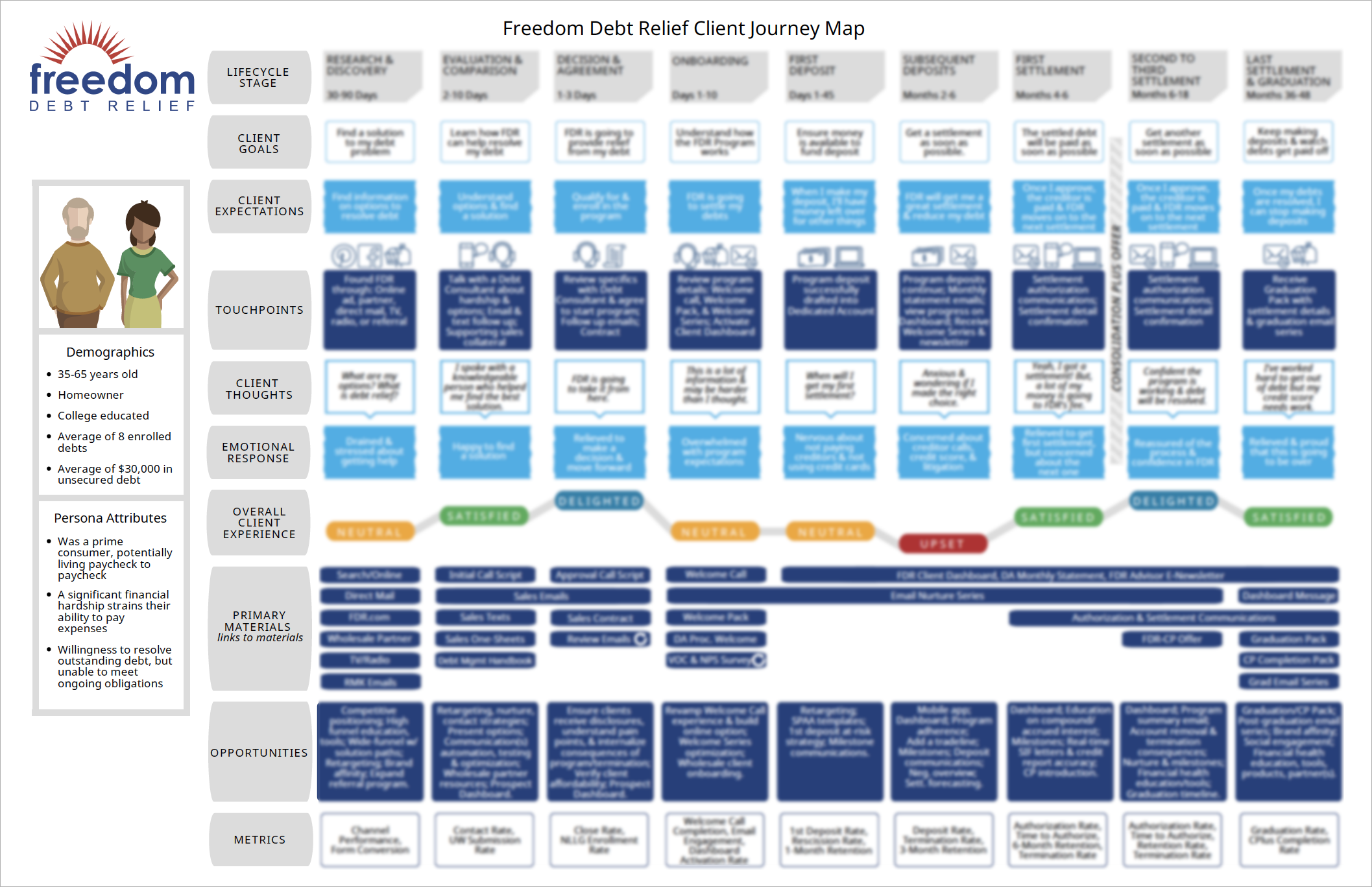
An example from Freedom Debt Relief: mapping the client journey required 2 client surveys, 12 remote client interviews, and 10 employee interviews — the kind of rigor the Discover stage is meant to enforce before a team commits to a direction.
- Better alignment across the design organization, cross-functional stakeholders, and executives.
- Executive confidence in project scope, timing, and expectations, restoring trust that had eroded.
- More successful projects, with fewer landing short of their goals.
- Better planning and better communication across every team the process touched.